
Why websites cost what they do
If you have ever asked a web developer for a quote and received the professional equivalent of “it depends,” you are not alone. Website prices in the Netherlands range from a few hundred euros for a simple landing page to tens of thousands for a complex e-commerce or business platform.
That range exists because a website is not one standard product. A small brochure site, an online shop, and a customer portal may all be called “a website,” but they require very different amounts of design, development, testing, security, and ongoing support.
The most useful question is not “What is the cheapest website I can buy?” It is “What does my business actually need the website to do?” A site that only needs to explain your services is a different project from one that handles bookings, payments, member accounts, or integrations with other systems.
It also helps to treat the website as part of your business rather than as a digital business card. It needs to load quickly, work properly on phones, make it easy for customers to contact you, and remain maintainable after launch. A low initial quote can become expensive if every small change requires a new invoice or if the site breaks the first time you update a price.
The four price tiers in the Netherlands
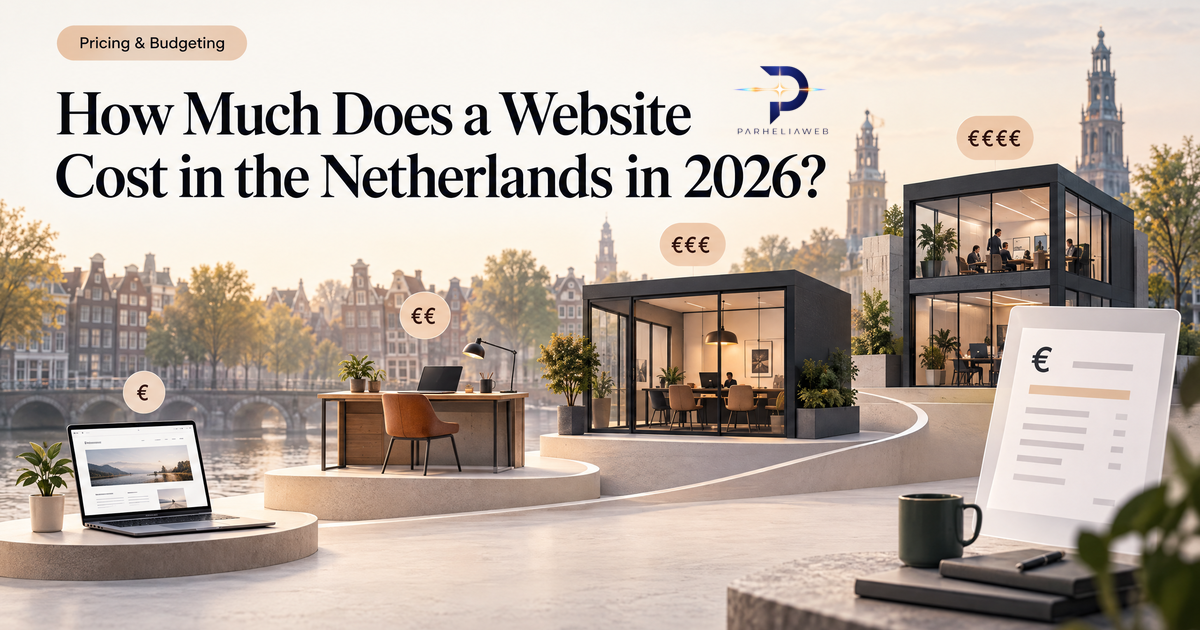
There is no official Dutch price list for websites, but four broad tiers are useful for comparing options. Each one can be the right choice in the right situation.
Tier 1 – DIY builders: roughly €0 to €300 per year. Wix, Squarespace, Webflow, and similar platforms let you build a site yourself with templates and visual editors. You pay less in cash, but you invest your own time and remain responsible for the content, structure, and design. This can work well for a hobby, a small side project, or a business that needs a temporary online presence.
Tier 2 – Freelancer-built: roughly €499 to €3,000. A Dutch freelancer or ZZP can design and build a site around your business, set up basic local SEO, make it work well on mobile, and communicate with you directly. This is often the practical middle ground for cafés, salons, small shops, independent professionals, and growing consultancies.
Tier 3 – Boutique studio: roughly €3,000 to €10,000. A small team may combine strategy, copywriting, design, development, and project management. You get more people involved and often a more extensive brand and content process, but you also pay for the extra coordination and overhead.
Tier 4 – Full agency: roughly €10,000 to €50,000 or more. Larger agencies may provide research, branding, UX, copywriting, development, campaigns, and long-term marketing. That can be worthwhile for a larger organisation with a serious marketing budget. For a small café or local service business, it is often more machinery than the project needs.
Factors that affect the final price
Once you know the broad tier, the project scope determines the actual quote. Comparing only the headline number makes it difficult to compare two offers fairly.
Number of pages: A focused landing page is much simpler than a multi-page site with separate service, team, location, FAQ, and blog sections. Each additional page needs structure, content, responsive layouts, and testing.
Functionality: A contact form is relatively straightforward. Bookings, payments, member logins, e-commerce, dashboards, and integrations add more development and testing time.
Design and content: A clean layout using your existing photos is faster than a complete brand refresh with custom photography, illustrations, animations, copywriting, and a new visual identity.
Performance and SEO: A site that needs to compete for valuable local searches and load quickly on mobile requires more care than a site that only needs to exist online. Technical details such as image optimisation, semantic HTML, structured content, and Core Web Vitals are easy to overlook because they are mostly invisible when they work.
Ongoing costs people forget
The build price is only one part of the budget. You may also need to pay for a domain, hosting, email, backups, security updates, maintenance, and occasional content changes.
For a small Dutch website, a domain may cost around €15 to €25 per year, while hosting might range from roughly €50 to €200 per year depending on the provider and the traffic. An SSL certificate is often included with modern hosting. Professional email is usually a separate service, such as Google Workspace or Microsoft 365.
Maintenance is optional, but the work itself is not. You can handle updates and backups yourself, or pay a developer for a monthly service. A modest maintenance arrangement may cost around €50 to €200 per month, depending on what is included. Ask whether the fee covers only technical maintenance or also content edits, monitoring, and support.
A maintenance plan is useful when you do not want to think about the technical side. It is less useful when it charges you every month for work your site rarely needs. The important thing is to understand the agreement before signing it.
Realistic Dutch price examples
These ranges are practical estimates for common small-business projects in the Netherlands. The final price depends on scope, content, integrations, and the amount of support required.
A single landing page for a barber, salon, or independent consultant may cost around €499 to €999 from a freelancer. That can include a mobile-friendly layout, contact form, basic local SEO, and deployment. A studio may charge €1,500 to €3,000 for a similar project if it includes more design and project management.
A multi-page business website for a consultancy, law firm, gym, or local service business may cost around €1,000 to €3,000 from a freelancer. A small studio may quote €4,000 to €8,000 when the project includes more extensive branding, copywriting, integrations, and coordination.
A small e-commerce site for a bakery or retailer may start around €2,000 to €5,000 from a freelancer, depending on the product catalogue, payment provider, shipping rules, and required integrations. A larger agency project can easily exceed €10,000.
How to choose the right tier
Start with the business problem, not the technology. If you are a solo consultant who needs a clear one-page site and a way for people to contact you, a freelancer in the €499 to €999 range may be entirely sufficient. If you need online ordering, bookings, payments, or a customer area, budget for the extra functionality rather than expecting it to appear for free.
A larger company may benefit from a studio or agency when it needs brand strategy, research, multiple integrations, ongoing campaigns, or several teams working in parallel. The higher tier is not automatically better; it is simply designed for a different level of complexity.
Whatever route you choose, ask for a written quote that clearly separates what is included, what is excluded, who supplies the content, and what happens when the scope changes. A suspiciously low quote often leaves out testing, content preparation, support, or ownership details. A transparent quote is not just easier to compare—it is the first sign that the working relationship may remain clear after the site goes live.
Want a transparent quote for your project?
We publish our pricing openly and quote in writing before any work begins.
View our pricing